Design Gateway × DYNANIC — Special Reference Design

Accelerate Cloud Storage
with FPGA-Based NVMe over TCP

Special Reference Design  for  FPGA-Accelerated Cloud Storage with NVMe/TCP Offload
NVMeTCP-IP (Design Gateway)  +  DMA IP + NVMe-Bridge (DYNANIC)
NVMe/TCP Full Hardware Offload Zero CPU Protocol Load QEMU/KVM + virtio-blk

An FPGA-based NVMe over TCP offload engine for cloud servers, designed to move storage and networking protocol processing away from the host CPU and into dedicated hardware logic. Built for virtualized cloud infrastructure where VMs need fast, scalable, and cost-effective access to remote NVMe SSD storage through standard Ethernet.

The Problem & Our Solution
Why Cloud Storage Needs FPGA Offload

In a typical cloud server, the CPU must run user VMs and also process network storage packets from the NIC. As cloud workloads grow, software-based NVMe/TCP processing can consume CPU cycles, increase power usage, and serialize storage request handling.
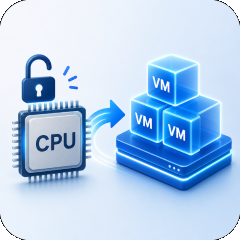
CPU Freed for VM Workloads

NVMe/TCP protocol processing is moved entirely into FPGA logic, so the host CPU is no longer burdened by storage networking tasks and can dedicate its full capacity to tenant virtual machines.

Hardware-Parallel Processing

Unlike sequential CPU software, dedicated FPGA logic handles multiple storage operations simultaneously — eliminating the queuing bottleneck that limits throughput under heavy I/O loads.
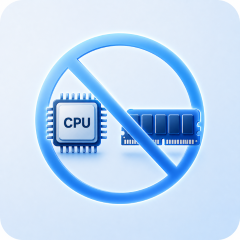
No DDR or CPU Required

The NVMeTCP-IP core operates without an attached CPU or DDR memory, reducing system complexity, board cost, and power draw compared to conventional SmartNIC offload approaches.

Reconfigurable Hardware
Reconfigurable Hardware — Future-Proof by Design

Unlike fixed-function ASICs, the FPGA fabric is fully reconfigurable — the same physical hardware can be restructured to meet new protocol specifications, updated standards, or custom offload requirements without replacing any equipment. This means the NVMe/TCP offload engine can evolve alongside your infrastructure.
Protocol Selection
NVMe/TCP vs. NVMe/FC

Two dominant high-speed storage networking protocols compete for cloud deployments. Here is why NVMe/TCP is the right choice for scalable, cost-effective cloud storage.

Feature NVMe/FC (Fibre Channel) NVMe/TCP (Ethernet)  ✦ Selected
Hardware Requirement Requires specialized Fibre Channel switches and HBAs Uses standard Ethernet infrastructure
Deployment Cost High (due to dedicated hardware) Lower (leverages existing networks)
Scalability Limited to Fibre Channel infrastructure Highly scalable across cloud environments
Flexibility Less flexible, dedicated to enterprise settings More flexible, supporting cloud-native storage
Latency Slightly lower latency Optimized with FPGA offloading for low-latency performance
Ideal Use Cases
Target Applications

Designed for virtualized cloud environments where storage throughput, CPU efficiency, and deployment simplicity all matter.

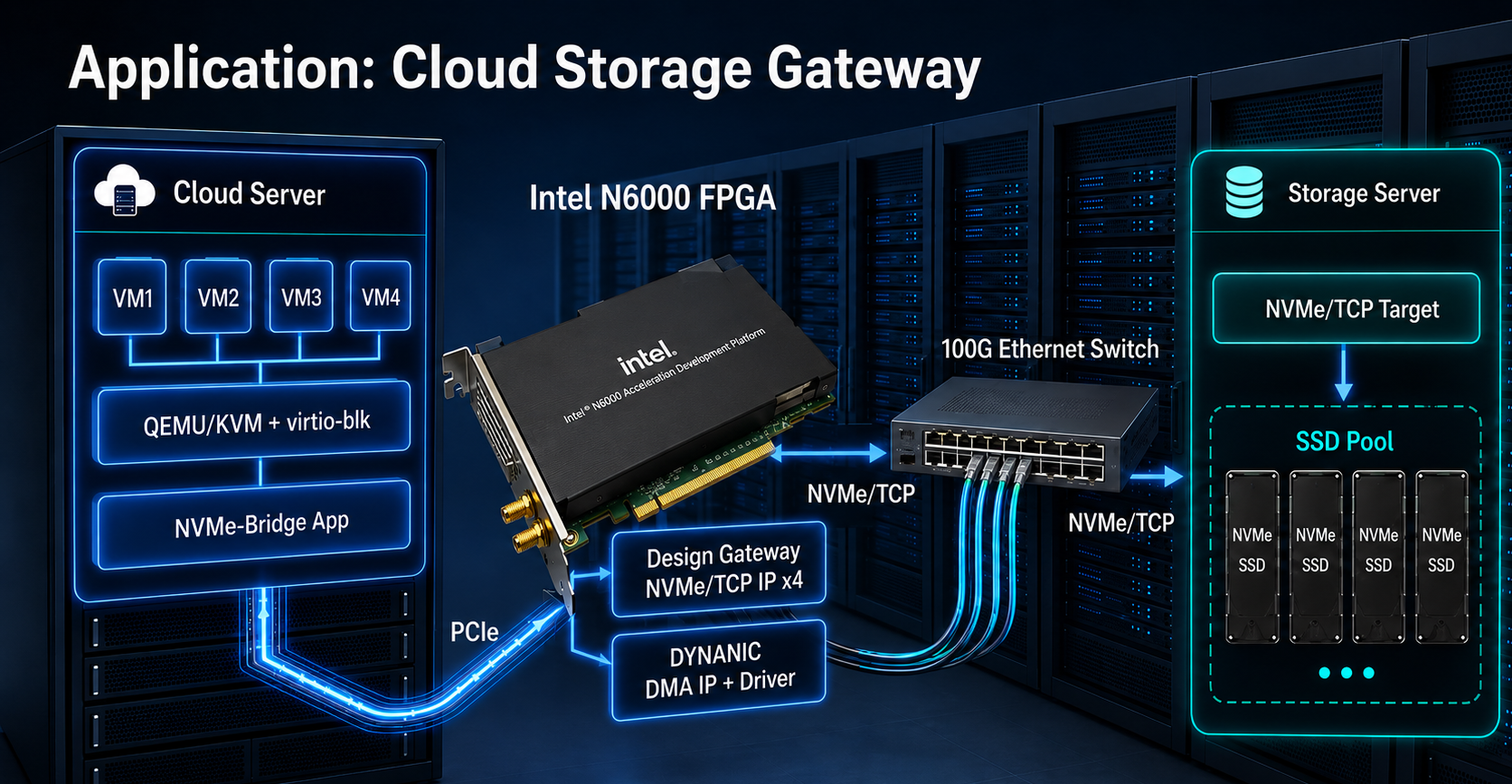
NVMeTCP25-IP Cloud Accelerator System Diagram

An FPGA-accelerated cloud storage gateway connecting VMs in a cloud server to remote NVMe SSDs over NVMe/TCP — with all protocol processing offloaded to hardware.

What You Need
System Requirements
Component AMD Altera
FPGA Card AMD Alveo U55C Silicom N6010
IP Core NVMeTCP25G-IP NVMeTCP25G-IP
DMA IP DYNANIC DMA IP
Host Software nvme-bridge + Driver
Host OS Oracle Linux 8.8 (Kernel 4.18)
Network 100G Ethernet (QSFP28, QSFP1 channel)
Storage Server Linux PC + NVMe SSD (Intel Optane SSD DC P5800X)
Evaluation & Downloads
Free Evaluation Demo

A free evaluation demo is publicly available for both AMD and Altera platforms, allowing you to directly verify NVMe/TCP offload performance on real FPGA hardware.

Refer to the documentation and bitfiles below to get started.

📋 Demo Instruction Manual 📄 AMD Setup Guide 📄 Altera Setup Guide 💾 Free Evaluation Demo Bitfile (AMD U55C) 💾 Free Evaluation Demo Bitfile (Altera N6010)
■ For a time-limited free evaluation, please contact us